Wednesday, September 16, 2015

My Philosophy, Part 6: I Am Wrong.


I am wrong.

This is, admittedly, a paradoxical statement.  

To be right, I must know reality, perceive all the options and be able to select the right one.  I have to know what is right and choose to act accordingly.  But, I don't know much of anything; I do not speak or hear the truth.  So, I cannot claim to be right about anything.  If I am right about anything, it was just dumb luck!

I am wrong.

But, since I am not special, everyone else is just as wrong as I am.  I am OK with that.

When this realization came to me, I just laughed.  A great burden was suddenly lifted from me.  I was wrong and that was OK.  I didn't have to be right all the time.  I am now free to explore everything, to create anything, and not worry about whether it was right or wrong or good enough.  I didn't have to take myself so seriously all the time.  Of course it was wrong!  How could it be right?  I don't know everything.  Of course I am going to make mistakes.  And that is OK.   That is what repentance is for; that is what apologies are for.  "Excuse me, my mistake."  Being wrong is really what makes me human.

Now, I will say that I am really good at obeying rules.  I sit still in my chair, raise my hand to talk, stand in line without pushing others, drawing within the lines, etc.  I try to be kind to others, empathetic.  I pay my dues, taxes, and tithing.  I don't drive over the speed limit (any more).  I obey the law, follow the rules, and adhere to policy.  I honor my contracts with others, and I try to keep my word.  I am good at following the norms, mores, and conventions of society.  And I probably still try to be right.  But, I don't believe I can.

I am wrong.    

My Philosophy, Part 5: I Am Not Special


I am not special.

I believe that I am unique.  My genes, inherited from my parents and my ancestors, have been recombined in a new arrangement through the marvel of sexual reproduction.  My environment, my family, my education, all my experiences have created me as a unique individual, but does that make me special?  I have the fortune of being born an American, white, and male.  I also sense that everything is around me; I am at the center of everything that I perceive.  I am at the center of my universe.  Does that make me special?

On a bell curve, any of my attributes is pretty average, within one standard deviation of the mean.  I am average; I am normal.  

My actual thinking about this was the question: do I have more of a right to God's blessings than anyone else on this planet?  Should my prayers be listened to more than those of a child in Somalia?  Or now with the current news, do I have more of a right to a home, to peace and security than a Syrian refugee?

I am very fortunate.  I enjoy many privileges and benefits that seem to be my birthright.  But, I do not merit my birth, I did not earn it.  And for me to say that I merit all the benefits of my birthright is arrogance in the face of all my brothers and sisters on Earth.  

Do I have a right to life?  Then why will I one day die?  The cancer cell, the virus, the bacteria, or the blunt force of a car crash all testify that I do not have the right to life.  I could not walk down the street in Syria, Iraq, or Afghanistan with any assurance of life or liberty.  I dare say that I could not walk in certain places here in America with total assurance of my right to life.

Do I have a right to liberty?  Then why do I often feel compelled to be and stay in a particular place when I do not want to be there?  Do I have a right to health?  Then why am I subjected to illness?  Do I have a right to free speech?  Then why am I afraid to speak my mind?  Why am I afraid of others reactions to this very blog post?  Do I have the right to happiness?  Then why does depression seem to run in my family?  If I were special, wouldn't I granted what I wanted and needed?

From experience I learned that I was not special.  I used to think I had all the answers, now I do not believe that.  I used to think there was a natural order of people in our society with the "better" ones on top.  I thought that our leaders were smarter, wiser, more spiritual, better than me; but as I became privy to the hierarchy of a few organizations, I found that the people on the top were not any smarter than the rest of us.  They were just on top.  They were not special, just as I was not special.

Not being special means that I am human.  I truly share this life and this world with all my brothers and sisters.  It means that my experiences will resonate with others.  It means that I can understand others, and others can understand me.  I have moved from my individualistic view of myself to a more democratic view, I am very much like everyone else.  I am me, but I am just one of billions living and breathing, sharing so much. 

I am not special.  I am your brother.


Tuesday, September 15, 2015

My Philosophy, Part 4: Without Truth


If I don't know, how can I tell the truth?

I define Truth as the accurate representation and communication of Reality.  I do not know how to do it.  First, I cannot know Reality.  I have too many limitations and filters to my perceptions to ever claim to know reality.  If I do not know anything, how can I tell anyone the truth?   I also find that as soon as have had an experience the memory of that experience begins to fade.  I lose many details, remembering only what is important to me.  The memory is distorted.

Second, communication requires coding that can be transmitted across the distance between two "stations."  The most common coding and transmission system is the spoken word with attendant body language, facial expressions, and hand gestures.  We have also developed the written word, which is really not the same as the spoken word, more static, and open for interpretation.  Communication requires ideas first be conceived, then coded, transmitted, decoded, and re-conceived.  It is a system that is full of errors.  It is no wonder that two people misunderstand each other so often.  Our language may not allow us to accurately represent Reality.  That is one reason a picture is worth a thousand words, and "you just had to be there."  Reading the New Testament, I have found that Jesus never actually describes the Kingdom of God, but alludes to it in parables.  It may be that our languages did not allow Him to accurately represent God, Heaven, or Hell to us.

Third, I have biases, and I have personal agendas.  I usually have a reason to tell a story.  I want to make a point, to entertain, to persuade, or to hide my guilt.  I believe that I always "spin" the stories I tell to fit the purpose I have in the conversation.  I am not telling the truth if I am trying to sell someone something.

The more I looked at Truth, the less I could claim to actually speak.  I do not tell the truth.  I tell others my beliefs and my opinions.  I tell stories.

And so do others.  I do not expect anyone to have a greater grasp of reality than I have.  Everyone else has the same limitations of perception, conception, and communication that I have.  We are all struggling to put into words what we have learned by experience in this life, in this world.  Two people can be standing together, shoulder to shoulder, see and hear the same things, and have different experiences.  Sadly, some of us are mistaken, some are mislead, misguided, some simply misunderstand... and some of us lie.  In stead of truth, we seem to have rhetoric.  I do not have to believe anyone, and I do not believe everyone... especially those with agendas: government officials, salesmen, politicians, religious preachers, scientists, teachers, doctors, etc. 

I note that I am very metaphorical.  I tend to visualize what I learn into models of nature.  I tend to put concepts into images of the weather, of mountains, of rivers, or of my garden or my home.  I will be more than happy to give you my opinion and the reasons I have for that opinion, but I will never tell you that it is the truth.  I try to be honest, but I do not speak or hear the truth.

Monday, September 14, 2015

My Philosophy Part 3: Not Knowing


Over many months of thinking I teased out six basic tenets of my philosophy.  Now I warn you that just reading the list, they will sound very negative.

  1. I do not know.
  2. I do not hear or tell the truth.
  3. I am not special.
  4. I am wrong.
  5. Nothing is perfect.
  6. It does not matter.
My first conclusion after examining everything I "knew," was that I really didn't know anything.  

Every experience I have had in life has been filtered through my senses, my neurology, my psychology, my language, and my culture.  I can only interpret my sensory input, I cannot actually know.  (see the TV series, Brain Games...) Practically, I can see, hear, taste, and touch things, but only the surfaces of those things.  I am completely cut off from the thoughts of others, relying on what I hear and understand them to say.  

I can say that I know the 2+2=4, and a lot of other "facts" that I learned in school, but most of those things are human concepts that we created to describe reality.  These concepts tend to be abstractions, generalizations, or labels we have put on things.  They are imaginary like the border between two states... there is no real line drawn in the sand.

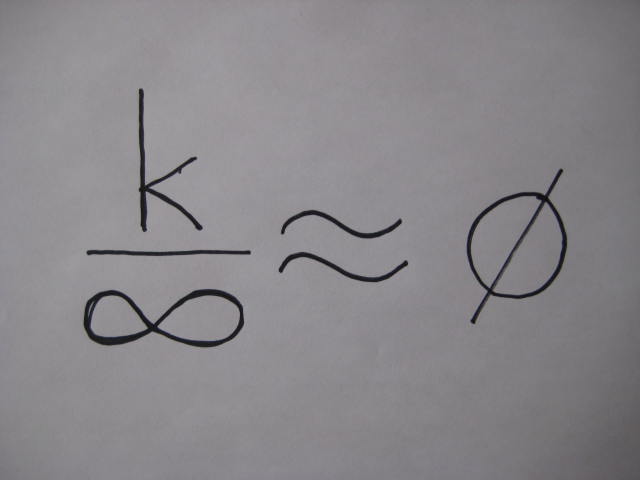
Then I can take everything I know (k) and divide it by everything that is real (R).  I believe that reality (R) may be infinite, at least it is incomprehensibly huge, and it is dynamic, always changing.  So, what I know, which is finite, divided by infinity is equal to zero... or approaches zero.  I comparatively know nothing.

So, I am out of touch with reality... the label we put on someone who is out of touch with reality is "psychotic."  I am psychotic, but that's OK, it really normal.

Not knowing, I can imagine.  I can believe.  I can hope.  I can perceive.  

The world, I now notice is full of "Knowers."  They are certain, sure, and they are always right.  (They also are eager to tell others what to do.)  I am not one of them; at best, I am a "believer."

My Philosophy Part 2: Metaphysics


What I think reality is the foundation that I use to build my worldview.  I have had many ideas about the nature of reality, I have backed away from them as I sought to free myself from anything imaginary.  Without the imagined, using only my own observations, I am left with a simple view of reality:

Reality is what it is.

I don't make too many more claims...  Reality may be infinite, but everything in it is finite.  Everything in reality is imperfect, but seems to work.  Everything is complex, connected, and interrelated.  Everything is dynamic, constantly changing.  Other than that, reality is a mystery to me.


And... I am what I am.

I am finite, mortal.  I am imperfect, human.  I am complex, connected and related to many, if not everyone else.  I am dynamic, constantly changing.  And I am a mystery to myself.

Imagination is not reality... but can be realized.

For a time I tried to sort out everything that was imagined from what was real.  Reality is like a sterile desert landscape, while the imagination creates lush gardens and jungles for the mind.  I have heard it said that plants and animals live in reality, but humans have added their imaginations to reality.  I have to concede that without our imaginations we would never solve any problems.  We could only evolve solutions to problems. Our large brains, with wildly rich imaginations have made us "human," and upon the foundation of our imaginations we have built our civilization.

Reality is what it is, I am what I am, and I have the ability to escape reality with my mind.

Saturday, September 12, 2015

My Philosophy Part 1. A brief introduction.


It dawned on me this morning that I should publish my philosophy... how I see things.  I have told a few people about it, but not everyone.  My philosophy is core to how I think, how I experience my life and the world around me, and who I am.

In August of 2000 I took a counseling position in a rural Nevada school district.  I dealt with the problems and conflicts of the students and teachers in the schools, I quickly learned that I could not depend on them to tell me the truth.  Sometimes they just lied, sometimes they were mistaken, many times they just saw things differently than everyone else.  Two people could be involved in the the same event, in the same room, and their stories of that event would not match.  I began to question whether I ever really heard the truth.

This began a self-examination of everything I thought I knew.  I discovered that in any empirical sense, I knew very little if anything.  I became unsettled and disoriented.  I felt that I was lost without any reliable navigational system.  I was not sure who I was, where I was, or where I should be going.  About all I could say was the I was here, now.

I used to be so sure of everything, and I would share that certainty, that knowledge with anyone; now I was not sure of anything.  The solid ground I once stood on had eroded into sand.  I used to be a "Knower," now I am at best a "believer."

In the next few posts I will present the conclusions that I could make after pulling everything out of the closets of my mind and really looking at them in the light of personal experience, evidence, and reason.  I do not claim to be right, or original in my thinking, but I will tell you that I have built my philosophy from the ashes of my previous certainty.

Friday, September 11, 2015

9/11


9/11.  I remember that day very well.  I was a counselor in Eureka, Nevada.  I came to school and heard the news.  We put a television out in the lunch room of the high school to watch the events unfold that day.  We watched the second plane crash into the second tower and knew the first was not an accident.  We watched the towers collapse and felt the weight of lives lost.  I don't think I will ever forget that day.

Now we have children who see these images as history.  They have no memory of that day.  So many events that I have witnessed have fallen into history.

Since September 11, 2001:

We surrendered our privacy and our civil rights to the Patriot Act to feel safe.

We sacrificed the lives, limbs, and families of our volunteer soldiers to feel like we have done something to someone about this attack on our homeland.

We have sacrificed many times more civilian lives as well as combatants than were lost that day.

We have paid billions of dollars to fight two simultaneous wars to defend our freedoms, money that could have been used here at home in so many ways.

We have struck targets in other sovereign nations with drones and troops.

We have detained foreign citizens in prison camps for years without trial.

And the Middle East is not better now than it was in 2001.  We now have the specter of ISIS in Syria.

We lost more than the thousands of innocent lives that day; we lost the moral high ground in the world, we lost the great country that we should be, that we believed we were, that we were told we were.

In the last few days, with thousands of refugees escaping the twin horrors of Assad and ISIS, some countries are accepting these victims into their borders, others are treating them like animals.  Our politicians wring their hands in our names, as our representatives, and worry about the security risks of accepting refugees into our country.

I don't remember the Statue of Liberty being bombed on 9/11...